


Across British Columbia, municipalities are responding to major changes in provincial housing legislation. The challenge is a familiar one: how can cities accommodate more homes while also protecting the qualities that make established neighbourhoods worth living in?
North Vancouver heritage planning offers an interesting example of how a city can accommodate new housing while continuing to protect established neighbourhood character.
Rather than treating housing growth and heritage conservation as mutually exclusive goals, North Vancouver has taken a more deliberate approach — increasing housing capacity across much of the city while recognizing that heritage neighbourhoods may require different planning tools, additional study and design guidelines tailored to their character.
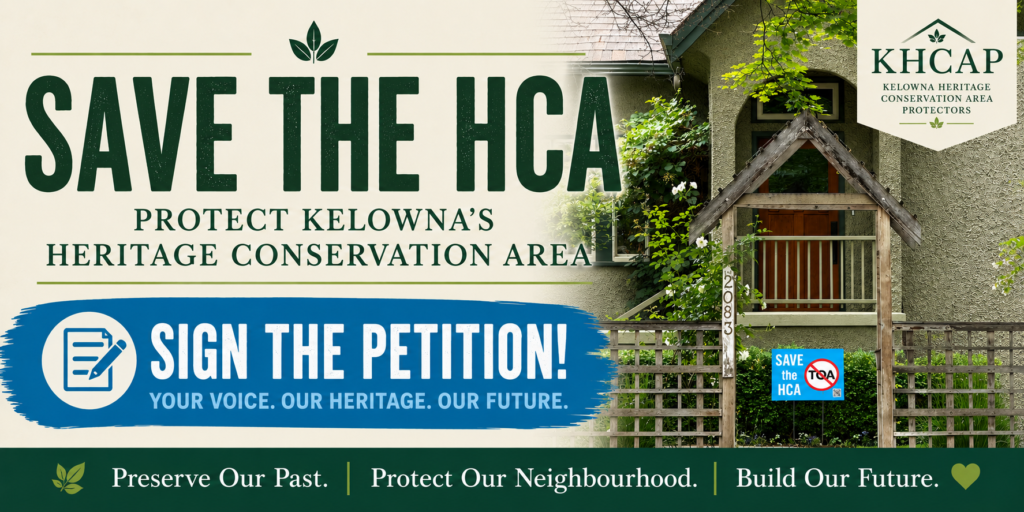
For Kelowna, where the Abbott Street Heritage Conservation Area is now facing significant development pressure, the comparison is worth examining.

North Vancouver Is Adding Housing — A Lot of It
It is important to begin with what North Vancouver is not doing.
It is not rejecting new housing.
In December 2025, North Vancouver City Council adopted a new Ground Oriented Zone as part of its Growing Livable Neighbourhoods initiative. The changes replaced several lower-density Official Community Plan designations with new ones permitting up to four and up to six dwelling units per lot.
The City says the new zoning added more than 6,600 units of residential capacity to its zoning framework.
The housing types contemplated are diverse: detached houses, coach or laneway homes, duplexes, triplexes, fourplexes, row houses, townhomes and secondary suites.
But what is especially notable is the philosophy North Vancouver attached to this growth.
The City describes low-density housing as one way it can grow while protecting existing neighbourhood character, explaining that additional homes can be introduced while maintaining the existing “look and feel” of residential neighbourhoods.
In other words, more housing does not automatically have to mean abandoning neighbourhood context.
Heritage Areas Were Given Separate Treatment
When North Vancouver adopted its new Ground Oriented Zone on December 8, 2025, Council also made a particularly significant decision.
It created a Heritage Special Study Area.
The City’s own description says the purpose was to:
“exempt Heritage Character Areas from the new ground oriented zone and the development permit guidelines, and to facilitate future engagement.”
That distinction matters.
Instead of automatically applying the same new municipal zoning framework everywhere, North Vancouver recognized that areas with identified heritage character warranted additional consideration.
The City increased housing capacity broadly while temporarily taking its Heritage Character Areas out of that particular zoning exercise so that their future could be examined separately.
That is a planning choice.
And it demonstrates something important: a municipality can support additional housing while still asking whether a one-size-fits-all approach is appropriate for neighbourhoods with recognized heritage value.
North Vancouver Heritage Planning Goes Back Decades

This response did not appear out of nowhere.
The City of North Vancouver says it has maintained an active municipal heritage program since 1987.
Its program includes five components:
- a Heritage Register;
- incentives for conservation;
- regulatory protection;
- heritage advocacy and public education; and
- ongoing monitoring of the heritage program.
The City’s Official Community Plan also includes objectives aimed at maintaining connections to the community’s natural and cultural past and encouraging understanding and appreciation of local history.
North Vancouver also maintains a Heritage Advisory Committee, involving residents, staff and a member of Council in ongoing discussion of heritage matters. Committee records show that provincial housing legislation and its potential effect on heritage properties have been specifically examined through this heritage lens.
That ongoing municipal infrastructure matters because heritage does not only become a consideration after a redevelopment proposal arrives.
It has a place in the planning process itself.
Then the Province Changed the Rules Again
North Vancouver’s experience is particularly instructive because the story did not end with the December 2025 decision.
In November 2025, the Province enacted Bill 25, expanding requirements for small-scale multi-unit housing.
Under the new requirements, the City says it must allow up to six dwelling units per lot in certain Frequent Transit Areas, remove minimum on-site parking requirements in those areas, and replace remaining single-detached and duplex zoning with zoning permitting three, four or six units.
Importantly, these provincial changes reach into some of North Vancouver’s heritage areas.
The City identified four affected areas:
Ottawa Gardens, Grand Boulevard, East 10th and Finlay’s Row.
This created a new challenge.
The City’s earlier Heritage Special Study Area could not simply override subsequent provincial requirements.
North Vancouver’s own Heritage Advisory Committee records are very clear on this point: properties in the Ottawa Gardens Heritage Conservation Area are not automatically exempt from provincial small-scale multi-unit housing requirements unless an individual property has qualifying heritage protection. City staff also reported that the Province had confirmed that Heritage Conservation Areas themselves were not generally exempt.
That is an important distinction.
But what North Vancouver did next may be even more relevant than the original exemption.
The City Asked: If More Housing Must Be Allowed, How Should It Fit?
North Vancouver did not respond to the new provincial requirements by concluding that heritage character no longer mattered.
Instead, the City stated:
“While provincial legislation requires the City to allow additional housing, the City retains an important role in shaping how new housing fits into neighbourhoods, particularly in areas with recognized heritage character.”
That sentence captures the heart of North Vancouver’s approach.
The municipality accepted that provincial legislation establishes certain housing requirements.
But it also identified the planning powers that remain with the City — particularly design guidelines and neighbourhood-specific planning — and began using them.
Residents Were Invited to Walk the Heritage Neighbourhoods
North Vancouver then undertook a heritage-focused public engagement process.
Between February and April 2026, residents were invited to participate in walking tours, information sessions, an online survey and an Official Community Plan town hall.
More than 270 people participated.
The walking tours are especially noteworthy.
Rather than discussing neighbourhood character entirely through maps and zoning tables, City staff invited residents to walk through heritage neighbourhoods and identify firsthand what mattered to them.
The purpose was practical: public input would help inform potential updates to design guidelines governing how future development should fit into those areas.
The City explains that its design guidelines address building and landscape requirements intended to ensure that development fits within neighbourhoods while respecting both character and livability.
This is a fundamentally different question from simply asking:
How many units can fit on this lot?
It also asks:
What should those homes look like, where should they sit on the property, how should landscaping function, and how can development respond to the place around it?
North Vancouver Recognized That Heritage Character Is a Planning Issue
There is another revealing statistic in the City’s own Bill 25 material.
North Vancouver reported that, of roughly 400 remaining single-detached and duplex properties affected by this stage of planning, approximately 260 were located within Heritage Character and Conservation Areas.
That helps explain why the City focused its consultation on heritage.
This was not a marginal issue.
Heritage properties represented a substantial share of the neighbourhoods affected by the regulatory change.
Rather than ignoring that fact, North Vancouver made it central to the planning conversation.
Heritage Protection and Heritage Character Are Not the Same Thing
North Vancouver’s experience also illustrates an important distinction that applies throughout British Columbia.
A neighbourhood can have recognized heritage character without every property within it being individually legally protected.
North Vancouver’s Heritage Advisory Committee recorded approximately 300 heritage properties in the city in early 2025, with about 20 per cent protected at that time.
Individual protections, Heritage Conservation Areas, Heritage Character Areas, heritage registers, zoning and design guidelines can all operate differently.
That is precisely why municipal planning decisions remain so important.
Heritage conservation is not simply a question of whether a demolition can legally be prohibited.
It is also about how new buildings relate to established streets, landscapes and neighbouring properties — and whether municipal policy encourages new development to reinforce or gradually erase the character the community has identified as valuable.
North Vancouver’s Current Bill 25 Work Is Still Evolving
There is one important caveat.
North Vancouver’s response to the latest Bill 25 requirements should not yet be described as a completed heritage solution.
City staff presented proposed Official Community Plan and Zoning Bylaw changes to Council on May 11, 2026. Council referred the proposals back to staff to incorporate feedback rather than immediately proceeding with them. The City’s current Bill 25 webpage continues to identify that referral as the latest Council decision published on the project.
So the final outcome of this newest phase should be watched carefully.
But the process itself already tells us something significant.
North Vancouver did not treat the existence of provincial housing legislation as a reason to stop considering heritage.
It treated it as a reason to determine which heritage tools were still available and how they could be strengthened.
What Can Kelowna Learn From North Vancouver?
Kelowna and North Vancouver are different municipalities, with different neighbourhoods, zoning histories, transit systems and local planning circumstances.
To understand what makes Kelowna’s neighbourhood unique, visit our Complete Guide to the Kelowna Heritage Conservation Area.
Their heritage areas are not legally interchangeable, and North Vancouver’s decisions cannot simply be copied and pasted into Kelowna.
But the comparison still raises an important policy question.
The Abbott Street Heritage Conservation Area was created because the City of Kelowna determined that this neighbourhood possessed collective heritage value.
If new provincial housing rules place additional development pressure on that area, does that heritage value become less important?
Or does it make thoughtful municipal planning more important?
The North Vancouver heritage approach reflects the latter view.
It has increased housing capacity.
It has complied with provincial housing requirements.
But it has also created a Heritage Special Study Area, maintained a longstanding municipal heritage program, involved a Heritage Advisory Committee, undertaken heritage-specific public consultation, walked affected neighbourhoods with residents, and explored design guidelines intended to make new development respond to established neighbourhood character.
That is not opposition to housing.
It is planning for housing in context.
Growth and Heritage Do Not Have to Be Opposing Goals
One of the most damaging assumptions in today’s housing debate is that communities must choose between preserving heritage and creating homes.
The North Vancouver heritage approach suggests a more constructive question:
How can we add housing while retaining the qualities that made these neighbourhoods valuable in the first place?
That question leaves room for new homes.
It leaves room for changing communities.
And it also leaves room for heritage buildings, mature landscapes, established streetscapes and neighbourhood identity.
Kelowna’s Abbott Street Heritage Conservation Area deserves the same kind of careful consideration.
Housing matters.
Heritage matters.
Good planning should be capable of considering both.
Sources & Further Reading
City of North Vancouver — Growing Livable Neighbourhoods
Official information on the adopted Ground Oriented Zone, new housing capacity and Heritage Special Study Area.
City of North Vancouver — Heritage in the City
Overview of the City’s heritage program, which has operated since 1987.
City of North Vancouver — Bill 25: Response to Provincial Requirements
Current City information on the latest provincial housing requirements and Council’s May 2026 referral of proposed changes back to staff.
Let’s Talk North Vancouver — Bill 25 Alignment
Details of the City’s heritage-focused engagement, affected heritage neighbourhoods, walking tours and design-guideline process.
City of North Vancouver — Bill 25 Provincial Alignment FAQ
City background material discussing parking, heritage areas, public engagement and the relationship between new housing and neighbourhood character.
City of North Vancouver — Heritage Advisory Committee Minutes, February 11, 2025
Detailed discussion of small-scale multi-unit housing, protected and unprotected heritage properties, the Ottawa Gardens HCA and the City’s available heritage tools.


