

Recent debate about growth in Kelowna raises a bigger question: can we build more housing while protecting the neighbourhoods, green spaces and heritage that make our city worth calling home? Other Canadian cities are showing that we can.
A recent exchange in Castanet’s letters section highlights an important question about responsible growth in Kelowna: asking how a city grows is not the same as asking it not to grow.
In an August 28 letter titled No to slowing growth, a writer challenged calls for slower or more managed growth, arguing that limiting development while people continue moving to Kelowna risks constraining housing supply and making the city less affordable.
The following day, another Kelowna resident responded in Not closing city border, arguing that managed growth is not about preventing people from moving here. Rather, he raised concerns about whether rapid development can outpace infrastructure, consume green space and ultimately diminish quality of life.
Both letters touch on a much larger conversation happening in communities across Canada.
And for Kelowna’s Abbott Street Heritage Conservation Area, that conversation raises a particularly important question: does every neighbourhood have to grow in exactly the same way?
We don’t think so. In fact, Kelowna’s own planning policies suggest otherwise.
Kelowna Already Planned for Growth in the Heritage District
Protecting the Abbott Street Heritage Conservation Area does not mean preserving every property exactly as it exists today.
Kelowna’s Official Community Plan already anticipated additional housing here.
The City describes the Core Area – Heritage District as an area intended to accommodate a “modest amount” of Kelowna’s future growth while remaining sensitive to the neighbourhood’s heritage-defining features.
The plan supports up to four residential units per property and specifically identifies housing forms including secondary suites, carriage houses, two-dwelling housing and house-plexes. It also encourages preservation of character-defining homes through Heritage Revitalization Agreements and other conservation tools.
In other words, the original choice was never simply “one house forever — or no housing growth at all”.
The plan envisioned something much more nuanced: more homes, delivered in forms compatible with a Heritage Conservation Area.
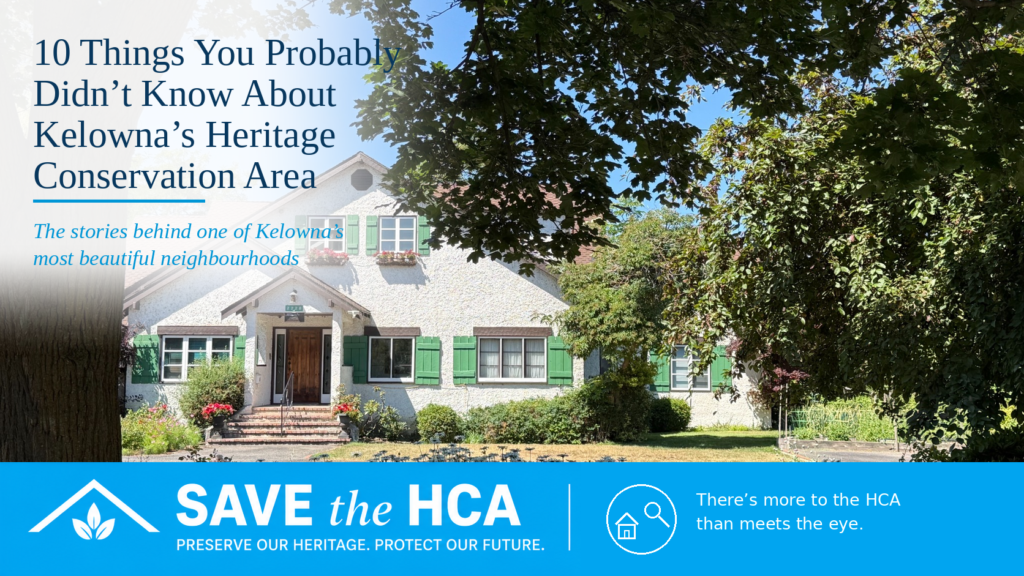
And there are good reasons for that approach. The Abbott Street HCA is already the kind of neighbourhood many modern planning policies are trying to create: centrally located, walkable, bikeable, tree-lined and close to parks, beaches, downtown, Kelowna General Hospital and everyday services.
Its mature tree canopy is not incidental. Kelowna’s HCA policies specifically identify mature trees and landscaping as defining characteristics of the neighbourhood, while the City more broadly recognizes its urban forest as a form of green infrastructure.
The question, then, isn’t whether the HCA should contribute to Kelowna’s housing needs. It already can. The question is what form that growth should take.
In fact, Kelowna’s newly updated HCA guidelines use remarkably similar language. They envision an area that “will continue to gently and thoughtfully densify,” while identifying the retention of contributory houses and mature trees as priorities when considering infill development.
Other Canadian Cities Are Asking the Same Question
Kelowna is hardly alone in confronting the tension between housing demand and heritage conservation.
What is interesting is that other Canadian municipalities are finding ways to accommodate substantially more housing without treating heritage preservation and housing supply as opposing objectives.
Some of those examples are remarkably relevant to Kelowna.
New Westminster: A B.C. HCA Meets Provincial Housing Reform

Perhaps the closest comparison is New Westminster’s Queen’s Park Heritage Conservation Area. Like Abbott Street, Queen’s Park is a formally designated Heritage Conservation Area in British Columbia. And like Kelowna, New Westminster is implementing major provincial housing reforms.
The City now allows substantially more infill housing, including small-scale multi-unit forms, as it responds to provincial requirements. But Queen’s Park did not simply cease being a Heritage Conservation Area. Renovations and new construction within the HCA can still require Heritage Alteration Permits and must comply with heritage design guidelines.
Even more interestingly, New Westminster says applications to demolish certain existing buildings in Queen’s Park must demonstrate that the density allowed on the property cannot reasonably be achieved without demolishing the building.
That turns the usual development question around. Instead of beginning with “What could replace this house?” the first question can become “Can we accommodate more housing while keeping it?”
That is a fundamentally different approach to growth.
New Westminster’s own Queen’s Park HCA objectives explicitly contemplate development and infill. The goal is not to stop change, but to accommodate development that remains consistent with the area’s heritage character.
That distinction matters.
A Heritage Conservation Area is not supposed to be a museum. It is a tool for managing change.
Victoria: Make Heritage Preservation Part of the Housing Solution

Victoria provides an even more deliberate example.
Faced with serious housing pressures of its own, the City introduced Missing Middle housing regulations intended to create alternatives between detached houses and large apartment buildings.
Those forms include houseplexes and townhouses—but Victoria also created a category with a particularly interesting name: Heritage Conserving Infill.
The idea is straightforward. Rather than demolishing a heritage building to unlock additional housing potential, additional homes can be constructed on the same property while the heritage building is retained.
Victoria describes this as allowing homes to be added through an addition or through separate infill housing elsewhere on the lot.
It turns heritage conservation from an apparent obstacle to density into part of the mechanism for achieving density.
Victoria also notes that houseplexes can resemble the scale of a large historic house while accommodating multiple residences and maintaining usable green backyard space and opportunities for trees.
That opens up an important conversation for Kelowna. Four homes where there was previously one are additional housing. A character house converted into several residences is additional housing. A heritage home with a carriage house is additional housing.
Sensitive infill behind an existing home is additional housing.
Housing supply cannot be measured by building height alone.
Ottawa: Eight Homes at Heritage-Neighbourhood Scale
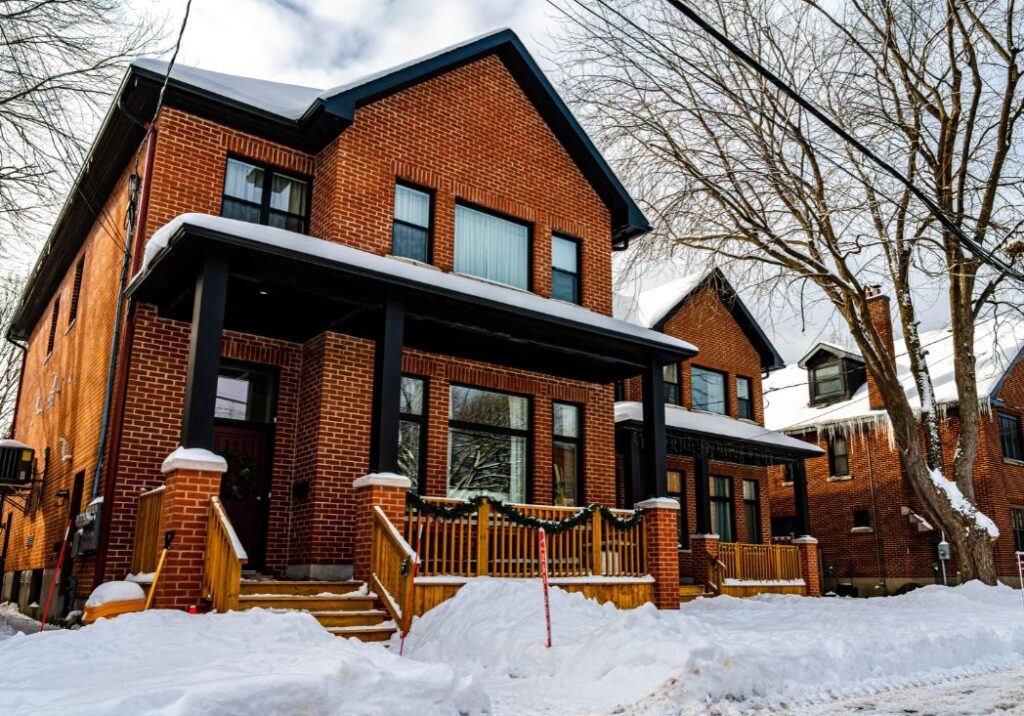
There are also examples where we can see the results.
At 189 Stanley Avenue in Ottawa’s New Edinburgh Heritage Conservation District, a non-contributing bungalow was replaced by two semi-detached buildings containing a total of eight homes.
Eight.
Yet Ottawa praised the project specifically because the new development maintained approximately the same character, scale, volume, massing, floor area and location as the building it replaced.
The project received an Award of Merit for Infill.
The City described it as an example of how density can be provided while respecting the scale of an established neighbourhood.
That is worth considering. The choice was not between preserving one detached dwelling and constructing a six-storey building. There was another point on the spectrum. Eight homes were accommodated at a neighbourhood-compatible scale.
Density Doesn’t Always Require Demolition
Ottawa provides another lesson in its Sandy Hill Heritage Conservation District.
At the Strathcona on the Parc development, two Queen Anne Revival heritage houses were restored while additional residential development was constructed behind them. The completed development contains 10 residential units. Again, the important lesson isn’t that Kelowna should copy an Ottawa project exactly.
Every property is different.
The lesson is that creative planning gives municipalities more than two choices. It doesn’t always have to be heritage house OR new housing. Sometimes it can be heritage house AND new housing.
That is precisely the kind of conversation Heritage Revitalization Agreements, adaptive reuse, conversions and sensitive infill are meant to encourage.
Density Can Be Good Planning
It is also important to acknowledge something advocates for additional housing get right.
Density can make cities more sustainable and less expensive to service than continued outward suburban expansion.
Putting more people close to existing shops, employment, transit and services can reduce infrastructure costs per household and support walking, cycling and public transit.
The argument for protecting the HCA therefore should not be an argument against density itself. Nor should it rely on the idea that all new development imposes unreasonable costs on existing taxpayers.
The better argument is that density is a planning tool—not a planning objective that overrides every other consideration.
Infrastructure capacity matters.
Trees matter.
Public spaces matter.
Housing matters.
Climate resilience matters.
Heritage matters.
Neighbourhood scale matters.
Good planning is the process of considering those objectives together.
Growth Doesn’t Have to Be Uniform
One of the problems with blanket zoning is that lines drawn around transit infrastructure don’t necessarily correspond with the characteristics of the neighbourhoods underneath them.
A radius on a map can cross apartment areas, commercial streets, institutional properties, parks and historic residential streets. Those places do not necessarily require identical planning responses simply because they fall the same distance from a transit exchange.
Kelowna’s Official Community Plan already recognizes this principle. Different parts of the city have different growth roles. Urban Centres can accommodate substantial density. Other parts of the Core Area can accommodate missing-middle and multi-unit housing.
And the Heritage District was specifically envisioned to accommodate modest growth that remains sensitive to its heritage-defining characteristics.
That isn’t anti-growth. It is planning.
Council Has Already Recognized the Conflict
There is another reason this discussion matters now.
Kelowna City Council itself has acknowledged the tension created by overlapping Transit Oriented Area requirements and the Abbott Street Heritage Conservation Area.
On June 15, 2026, Council passed a resolution asking the Province to exclude the Abbott Street HCA from the Transit Oriented Area.
Mayor Tom Dyas subsequently wrote to provincial ministers on Council’s behalf, describing the overlap as creating “policy uncertainty and tension” between heritage preservation and future growth. The letter also recognized the HCA’s distinct character, mature streetscape and cultural value, built through decades of community investment and stewardship.
That acknowledgement is significant.
The question is no longer simply whether residents are uncomfortable with change. The City itself has recognized that two legitimate planning objectives are colliding. The challenge is finding a better way to reconcile them.
What Could Responsible Growth Look Like in Kelowna’s HCA?
Perhaps the most useful lesson from New Westminster, Victoria and Ottawa is that we should stop imagining only two possible futures.
Protecting the Abbott Street Heritage Conservation Area doesn’t necessarily mean one detached house on every property forever. And accommodating more residents doesn’t necessarily require replacing its historic streetscape with six-storey buildings.
There is an entire spectrum between those extremes:
- secondary suites and home conversions;
- carriage and garden houses;
- duplexes, triplexes and houseplexes;
- sensitive ground-oriented infill;
- smaller multi-unit buildings designed around neighbourhood scale;
- adaptive reuse of existing character homes;
- Heritage Revitalization Agreements that exchange additional development opportunities for permanent heritage protection;
- additions constructed behind or alongside retained heritage buildings.
Not every solution will work on every property. But that is precisely why context-sensitive planning exists.
What Does Responsible Growth in Kelowna Look Like?
The recent Castanet exchange framed an important question about responsible growth in Kelowna—one the city will continue confronting as its population increases.
How do we remain welcoming?
How do we provide enough housing?
How do we make efficient use of existing infrastructure?
Those are legitimate questions. But so are these:
How do we retain mature urban tree canopy?
How do we protect places that tell the story of our city?
How do we avoid replacing the very qualities that make established neighbourhoods desirable?
And how do we ensure that today’s response to a housing shortage does not unnecessarily erase assets that cannot be recreated once they’re gone?
Other Canadian cities aren’t answering those questions perfectly. But they demonstrate something important. Housing and heritage do not have to be enemies.
New Westminster is accommodating provincial housing reform while maintaining heritage review in Queen’s Park.
Victoria has literally incorporated heritage conservation into its infill housing strategy.
Ottawa has demonstrated that eight or ten homes can sometimes be accommodated while respecting established heritage character or retaining heritage buildings.
These aren’t arguments for stopping Kelowna’s growth. They are evidence that we have more choices about how we grow than the current debate sometimes suggests.
The Abbott Street Heritage Conservation Area occupies a tiny part of a rapidly growing city. Protecting its distinctive streetscape while allowing thoughtful, compatible housing would not mean closing Kelowna’s doors. It would mean recognizing that a successful city doesn’t need every neighbourhood to become the same.
The question isn’t whether Kelowna should grow.
It’s whether every neighbourhood must grow in exactly the same way.
We believe Kelowna can grow—and still remain Kelowna.
Sources & Further Reading
This article draws on current planning and heritage policies from the City of Kelowna, City of New Westminster, City of Victoria and City of Ottawa, as well as the June 15, 2026 Kelowna City Council resolution and June 30, 2026 letter from Mayor Tom Dyas to the Province. Links to the relevant primary sources are included throughout the article.