
What should Kelowna’s next City Council do about heritage, density and local decision-making?
A recent Vancouver Sun column by Douglas Todd examines the B.C. Conservatives’ housing policies and the growing disagreement over provincial housing mandates and municipal autonomy. Among the issues raised are provincially required upzoning, transit-oriented development, and how much discretion cities should retain over local land-use decisions.
Housing policy has become one of the defining issues in British Columbia — and with the Kelowna election 2026 campaign underway and voters heading to the polls on October 17, 2026, the debate is no longer confined to Victoria.
For Kelowna, that debate is particularly relevant.
Here, the Kelowna General Hospital Transit-Oriented Area overlaps part of the Abbott Street Heritage Conservation Area — bringing two very different planning objectives into the same neighbourhood.
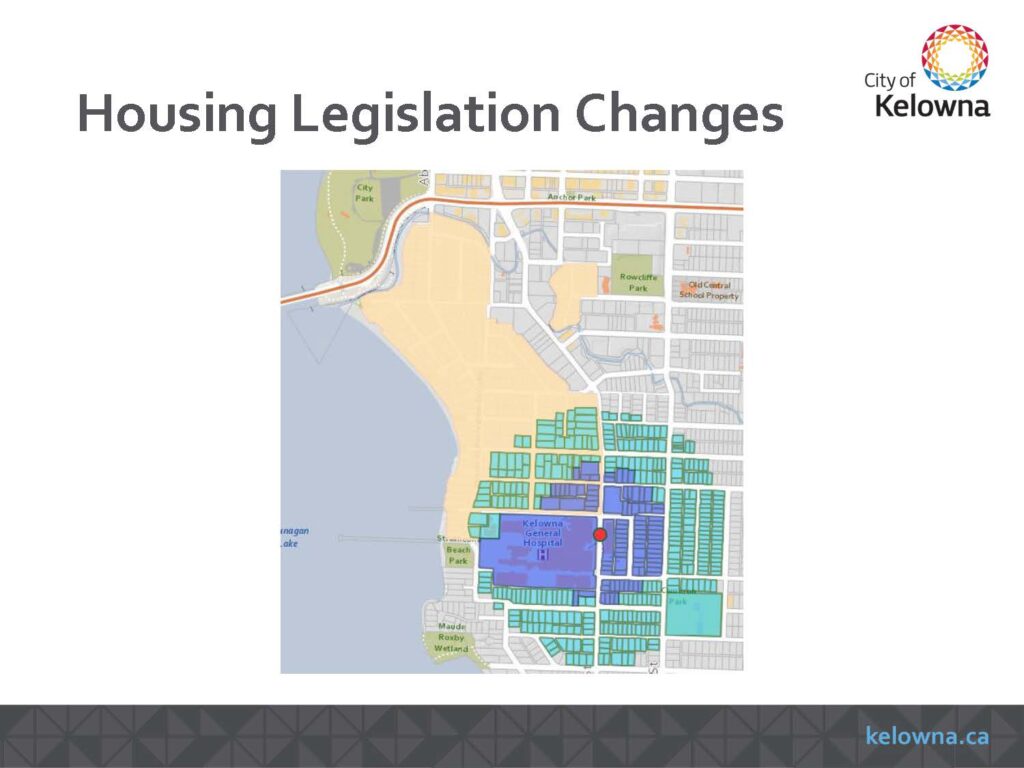
The Province requires municipalities to permit minimum densities within designated Transit-Oriented Development Areas. Municipalities may also choose to allow densities beyond those provincial minimums.
At the same time, B.C. law gives local governments several tools for heritage conservation, including heritage designation, heritage revitalization agreements and Heritage Conservation Areas established through an Official Community Plan.
That creates an important question for Kelowna voters:
Within the rules established by the Province, what choices should our next City Council make about the Abbott Street Heritage Conservation Area?
What the Province requires — and what Kelowna still controls
There is an important distinction here.
The City of Kelowna has stated that the designation of the KGH Transit-Oriented Area is a provincial decision and cannot simply be removed by City Council. The City also says it must allow the provincially required minimum density and building height within the TOA.
But that does not mean City Council has no role.
In its own explanation of the issue, the City says it can still regulate development form and character, protect heritage buildings and sites, and exclude certain protected heritage sites from density provisions when implementing TOA bylaws.
The City has also said that the Abbott Street HCA guidelines remain in force and that transit-oriented growth and heritage conservation are intended to operate together.
Those statements make the upcoming municipal election particularly relevant to the future of the neighbourhood.
The question is no longer simply: “Does the Province require density?” In many cases, it does. The more useful questions are:
How will Kelowna implement that density? What heritage protections will it retain or strengthen? And where does Council believe the appropriate balance lies?
Heritage conservation remains a municipal responsibility
The Province itself recognizes that local governments have an important role in heritage conservation.
Municipalities can maintain community heritage registers, formally designate heritage properties, enter heritage revitalization agreements and establish Heritage Conservation Areas through their Official Community Plans.
Kelowna’s own Official Community Plan also says the City should prioritize the retention, maintenance and protection of the streetscapes, landscapes, cultural resources, properties, buildings and other contributory features of its Heritage Conservation Areas.
The City’s current HCA guidelines likewise say that new development should be compatible with, distinguishable from and subordinate to the existing historic context, while allowing change and density to be managed within the area.
These tools exist precisely because communities sometimes need to accommodate growth while protecting places that have cultural, architectural or historical significance.
That makes the Abbott Street HCA more than a debate about whether Kelowna should build housing.
Kelowna will grow.
The more specific question is how that growth should occur in one of the city’s established heritage areas.
Related: Why Kelowna’s Heritage Area Matters to Everyone →
Five questions worth asking municipal candidates
As the election campaign continues, residents may want to ask mayoral and council candidates some very specific questions:
- Do you support retaining six-storey zoning within the portion of the Abbott Street Heritage Conservation Area that overlaps the KGH Transit-Oriented Area?
- Should Kelowna seek additional flexibility from the Province for established Heritage Conservation Areas?
- Would you support stronger protection for properties that contribute to the historic character of the Abbott Street HCA?
- How should Council reconcile provincial housing requirements with the City’s own heritage policies and design guidelines?
- Where provincial rules establish minimum density, should Kelowna generally stay at those minimums in sensitive heritage areas, or consider additional density where Council believes it is appropriate?
These are questions candidates can answer regardless of provincial party politics.
And they would tell voters considerably more about the future of the neighbourhood than broad statements about being either “pro-housing” or “pro-heritage.”
This election is about implementation
It would be misleading to suggest that a municipal election can undo every provincial housing requirement.
It would be equally misleading to suggest that City Council has no meaningful choices left.
The provincial Transit-Oriented Development framework establishes minimum densities in designated areas, while municipalities retain important planning and heritage responsibilities.
In Kelowna, those two systems now overlap.
That means the next Council will inherit decisions about how heritage guidelines are applied, how redevelopment proposals are evaluated, what additional heritage tools should be used, and whether the City should continue advocating to the Province for changes or greater flexibility.
Those are municipal decisions — and they deserve to be part of the municipal election conversation.
You can also contact current City Council directly through our Write to Council page.
Before you vote, ask where your candidates stand.
Not simply on “housing.”
Not simply on “heritage.”
Ask them how they believe Kelowna should accommodate growth while protecting the places that make the city distinctive — and what they would actually do about it once elected.